
Why Basic Engineering Study is Essential for Process Plants
Why Basic Engineering Study is Essential for Process
Plants with need of Bulk Solids Handling
Imagine building a house without a blueprint. You might end up with crooked walls, awkward spaces, or worse—structural instability. Now, think of a bulk solids handling system the same way. Whether you are handling flour, cement, chemical powders, plastic pellets, or minerals, having a detailed plan is everything. It is of upmost importance to verify how the design for handling your specific powder, flakes or granules can be accommodated in your process. And that’s exactly where Basic Engineering Studies, also known as Front End Engineering Design (FEED) come into play.

In this blog, let us walk through why these early-stage studies are not just important—but essential—for the success of any bulk solids handling project.
So, What Exactly Is a “Basic Engineering Study”?
In simple terms, it is the technical foundation of your project.
Think of it as the bridge between an idea and a fully functional system. This study outlines all the key technical and design elements required to turn your bulk solids handling concept into a practical, executable solution.

Here is what a typical Basic Engineering Study includes:
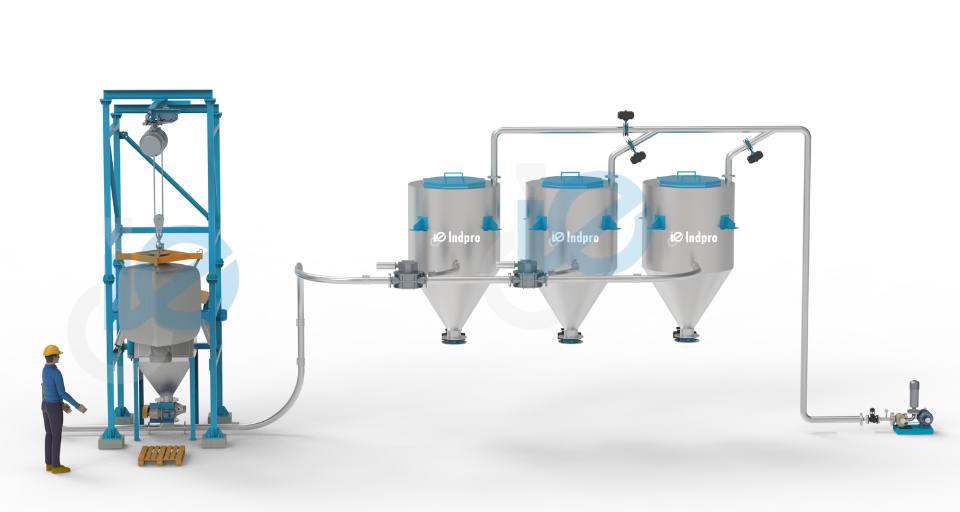
- Process Flow Diagrams – To visualize how materials will move through various equipment in your system from point A to point Z.
- P&IDs (Process & Instrumentation Diagrams) – A technical snapshot of your valves, instruments, pipelines, and process control logic.
- Equipment Sizing & Selection – Choosing the right type and size of feeders, conveyors, blowers, filters, and more, based on your material properties and system requirements.
- General Arrangement (GA) Drawing – Showing how all major components fit together within your available space.
- Layout Drawings – A birds-eye view of the physical arrangement, including equipment spacing, piping routine, walkways, maintenance areas, essential supports, etc.
- Foundation and Cutout Drawings – Providing critical data for civil and structural teams to design necessary RCC pedestals, support floor openings, and anchoring.
- Cable Tray Layout – A detailed plan for routing power and control cables efficiently and safely across the plant, ensuring ease of maintenance and future scalability.
- Utility Consumption Estimates – Air, water, electricity, and gas requirements to run the system efficiently.
It is the phase where ideas take form—not fully built but clearly visualized.
Why Is It So Important in Bulk Solids Handling?
Bulk solids don’t flow like liquids—they tend to behave unpredictably and often defy straightforward patterns. They can bridge, rat-hole, segregate, or even combust under the wrong conditions.
So, designing systems to handle them needs more than guesswork—it needs engineering backed by data and experience.
Here’s what a Basic Engineering Study helps you to avoid:
1. Costly Mistakes Later Down the Line
Making changes mid-project? That’s expensive.
Changing a silo design after fabrication, redesigning a ductwork layout after construction, or fixing material flow problems post-installation can blow your budget.
With a proper study, these risks are reduced dramatically.
2. Equipment That Doesn’t Fit—or Work
Bulk solids vary in particle size, density, moisture content, and flowability.
What works for cement might clog up with starch or sugar. The study helps determine what type of feeder, valve, or conveyor is ideal based on your exact material properties.

3. Delayed Project Timelines
Guessing your way through design leads to scope creep, rework, and missed deadlines.
Basic engineering gives you a clear scope and schedule, ensuring smoother project management.
The Real-World Benefits You’ll See
We’ve talked about why it matters—now let’s look at how it actually benefits you in real-world scenarios.
✅ 1. Better Project Planning
You’ll get a clear picture of what your project will look like—space needed, scope clarity and timeline to completion.
It helps align your engineering, procurement, and construction teams from Day One.
✅ 2. Improved Equipment Selection
A screw conveyor or pneumatic conveying? Pulse jet filter or wet scrubber?
The study helps make these decisions based on logic and calculations, not assumptions.
This leads to higher efficiency and fewer surprises.
✅ 3. Enhanced Safety & Compliance
Dust, static, or combustible powders? These aren’t just operational challenges, they’re safety hazards.
The study identifies safety risks early, so you can build safeguards right into the design.
✅ 4. Seamless Integration with Existing Systems
Already have part of the setup in place? Basic engineering looks at how the new system will fit into your current infrastructure—whether that’s a process line, control panel, or PLC logic.
It’s Not Just Basic Engineering—It’s Risk Management
In the world of bulk solids, flow issues are common—but they’re also preventable.
A well-executed basic engineering study is like an insurance policy. It protects your investment by predicting and preventing the most common causes of failure: improper flow design, under- or over-sized equipment, and process inefficiencies.
It’s not about overengineering—it’s about engineering smart.
When Should You Go for a Basic Engineering Study?
Anytime you’re:
- Setting up a new plant or greenfield project
- Expanding or upgrading an existing line
- Adding new materials or process changes
- Facing chronic material handling problems
It’s particularly valuable in sectors like:
- Food & beverage
- Chemicals
- Plastics
- Cement & minerals
- Pharmaceuticals
Don’t Skip the Basics
In today’s fast-paced industrial world, it’s tempting to jump straight to execution. But when it comes to bulk solids handling, rushing the design phase can cost more in the long run—in money, time, and headaches.
By investing in Basic Engineering Studies, you’re not just buying documents—you’re buying clarity, control, and confidence.
So, the next time you’re planning a material handling system, ask yourself:
So, the next time you’re planning a material handling system, ask yourself:
“Are we starting with the right blueprint?”
Because with the right foundation, everything else becomes easier.
Want Expert Help?
At Indpro, we specialize in designing customized bulk solids handling solutions—and it all starts with a detailed basic engineering study with full functional project executions.