
Safe & Smart Pneumatic Conveying of Combustible Silicon Powder for Anode Manufacturing
Safe & Smart Pneumatic Conveying of Combustible
Silicon Powder for Anode Manufacturing
Silicon powder might look like just another fine grey dust… but it packs a powerful punch—both in performance and risk.
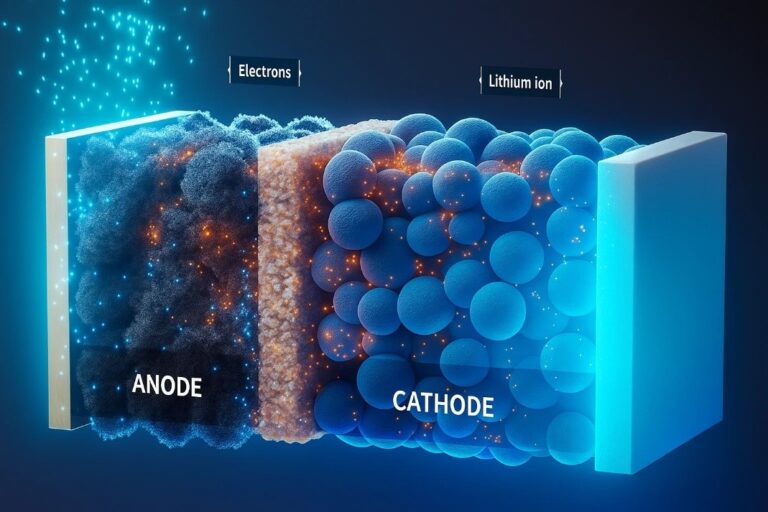
As the world shifts toward next-gen energy storage solutions, silicon anodes have become the star players in lithium-ion battery innovation. They promise significantly higher energy storage capacity than traditional graphite anodes. But with that advancement comes a critical handling challenge—safely transferring highly combustible silicon powder during production.
Let’s break this down together—what silicon powder is, why it’s tricky to handle, and how pneumatic conveying systems come to the rescue with safe, efficient, and dust-free transfer.
What Is Silicon Powder?
Silicon powder is a finely milled form of silicon metal, typically used in high-tech industries—especially for anode material in lithium-ion batteries. Its particle size usually ranges from 0.1 to 10 microns, making it ultrafine, lightweight, and—yes—highly reactive.

Properties of Silicon Powder That Matter:
- Extremely Fine: Low particle size means large amount of dusting.
- High Bulk Density: Tends to compact, making it hard to control.
- Combustible Dust: When dispersed in air, it can form explosive atmospheres.
- Abrasive Nature: Can cause wear and tear on mechanical components.
- Moisture Sensitive: Absorbs humidity and can clump if not handled correctly.
Why Pneumatic Conveying? Why Not Just Use a Screw Conveyor or Bucket Elevator?
You could try using mechanical conveying systems, but here’s the catch: they often involve lots of moving parts, open transfer points, and more friction, which are exactly the conditions that increase ignition risk when handling combustible dust like silicon.
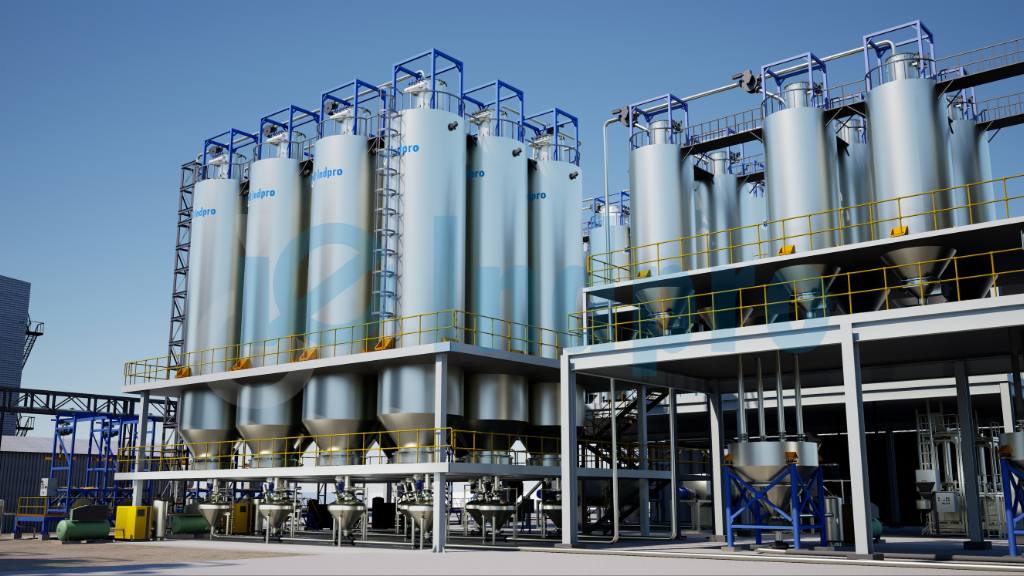
Pneumatic conveying uses air pressure or vacuum to move bulk materials through enclosed pipelines. For materials like silicon powder, it’s not just efficient—it’s vital for safety.
Why Pneumatic Conveying Wins for Safety for Silicon Powder Conveying:
- Closed Conveying System: Prevents dust leakage and contains explosion risks.
- Minimal Moving Parts: Reduces mechanical friction and ignition sources.
- Gentle Material Handling: Maintains particle integrity for battery-grade material.
- Inert Gas Conveying Option: Use of nitrogen or CO₂ instead of air helps eliminate oxygen, reducing combustion risk.
- Dust-Free Operation: Protects workers and keeps the environment clean.
It is the perfect blend of safety, control, and performance—especially in a cleanroom or classified area.
Inside the Process: A Real-World Case Study
Let us walk through the actual material flow at a battery raw material manufacturing company, step by step, and how they designed each stage for safety and efficiency:
Great question. Let’s break it down:
1. Bag-Dump Station with Dust Collection
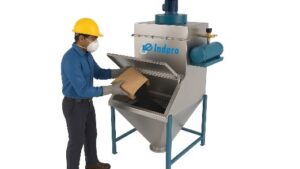
Operators manually empty silicon powder bags into a sealed dump hopper. Airborne dust is captured by dual cartridge filters equipped with reverse pulse jets, which clean and return dust to the hopper—keeping particles contained and the environment clean.
2. Pneumatic Conveying Line
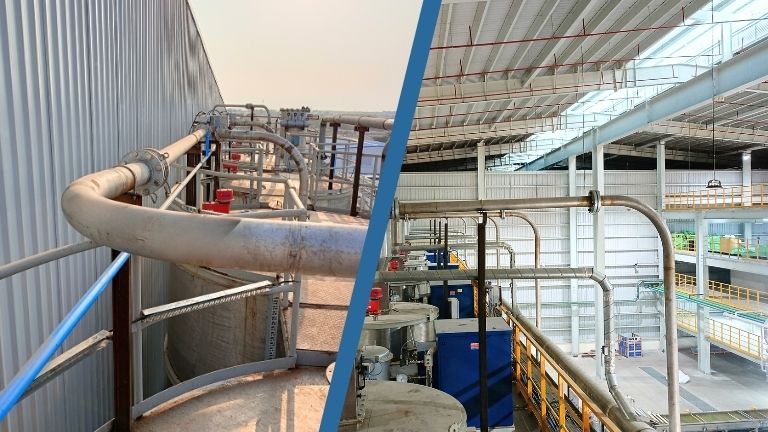
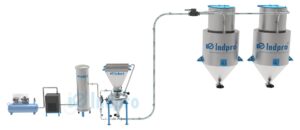
From the hopper’s outlet, silica flows into a pickup adapter, then rises vertically 90°, transitioning to a horizontal pipeline toward the main area. A blower creates vacuum to draw the powder—ensuring containment even if there’s a leak.
3. Filter-Receiver and Slurry Tank Feed
At the pipeline’s end, a filter-receiver separates powder from airflow. It also uses reverse pulse jets for self-cleaning. A vacuum relief panel ensures any explosion is vented and equipment is protected.
4. Controlled Discharge via Slide Gate Valve
Powder exits into the slurry tank through a pneumatically actuated slide valve. There’s also two-stage load-cell weighing—one under the bag dump, another under the filter-receiver—feeding data to a PLC for precise batching. Level sensors halt the process during refill or if the receiving hopper nears overflow
Why it’s smart: Fully enclosed, filtered, automated, and vacuum-safeguarded. Even a breach in the line keeps dust contained thanks to negative pressure.
What Makes This Setup Explosion-Safe?
The system includes:
- Cartridge filters with reverse pulse cleaning—no manual intervention needed
- Vacuum conveying—dust remains inside even if there’s a leak
- Explosion relief panel—ensures safe pressure release
- Grounded metalwork, inert gas purging potential—common industry best practices
- Integrated PLC with load-cell and level sensing—automated and safer weighing & batching control
It’s a textbook case of designing safety into every stage—from powder deposition to delivery.
Bringing These Lessons to Your Setup
Here’s how you can adopt this model effectively:
Smart Safety Adaptations for Silicon Powder Conveying
| Element | Adaptation Tips |
|---|---|
| Bag-dump station | Use sealed hoppers with dust filters that auto-clean |
| Vacuum-based pneumatic line | Ensure negative pressure to contain dust even during leaks |
| Filter-receiver with explosion venting | Include reverse-pulse cleaning and relief panels |
| Automated discharge & batch control | Use weigh cells and PLCs to manage feed rates and safety |
| Inerting options | Purge with nitrogen or CO₂ during startup |
| Regular inspection | Periodically check seals, valves, and grounding systems |
Handling combustible silicon powder isn’t just about boosting production—it’s about protecting lives, assets, and investment. The above setup is a real-world example of how a well-engineered pneumatic conveying system can make a hazardous process safe, reliable, and efficient.
Here’s to smarter—and safer—powder handling as we build next-gen batteries!