
The Hidden Cost of Poor Material Feeding in Pneumatic Conveying
The Hidden Cost of Poor Material Feeding in Pneumatic Conveying
In pneumatic conveying, the most expensive problems are often not created in the pipeline: They begin upstream.
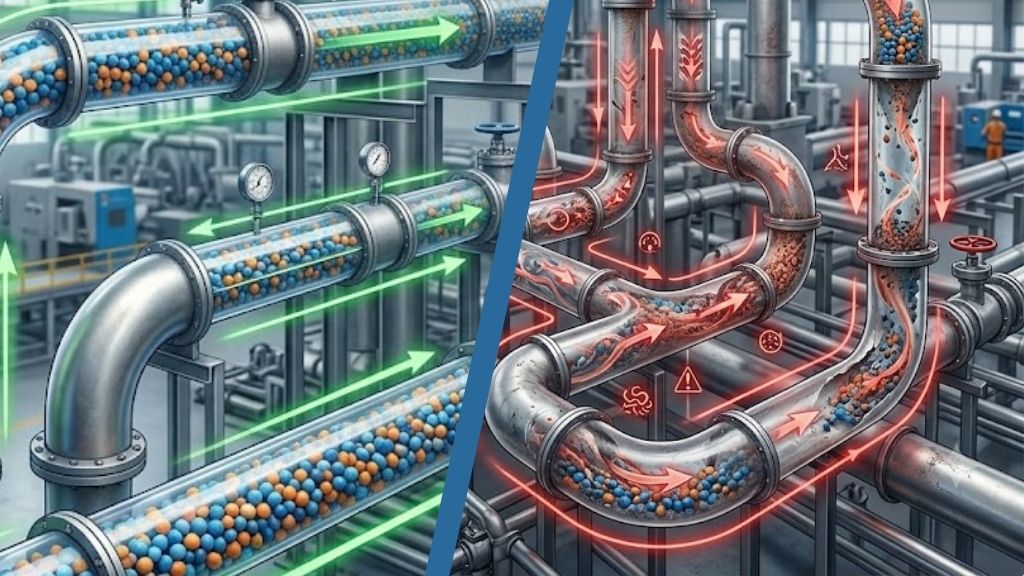
A conveying system can be correctly sized, carefully engineered, and equipped with an efficient blower – yet still underperform because material is entering the conveying line inconsistently. When the feed device floods, starves, surges, aerates, compacts, or simply fails to maintain a stable solids-to-air ratio, the entire system is forced to operate outside its intended design envelope.
The result is a deceptively familiar pattern: higher energy consumption, unstable throughput, excessive wear, filter loading, product degradation, frequent blockages, and operators constantly adjusting equipment to compensate.
The mistake is to treat feeding as a mechanical handoff.
In reality, the feeder is the point where the material process becomes a conveying process.
That makes feeding one of the most consequential – and frequently underestimated – variables in pneumatic conveying.
The Feeder Is Not Just a Valve Between Processes
A pneumatic conveying system has two fundamentally different phases.
Before the material enters the conveying line, it behaves according to gravity, bulk-solid mechanics, hopper geometry, moisture, particle size distribution, cohesiveness, and other material properties.
Once it enters the pipeline, its behavior is governed by airflow, particle velocity, pressure, suspension, acceleration, friction, and phase regime.
The feeder sits at the boundary between these worlds.
Its job is therefore more sophisticated than simply delivering material at a specified rate. It must introduce solids into an air stream at a controlled and repeatable rate while maintaining the pressure boundary of the conveying system.
When this interface is poorly controlled, disturbances propagate downstream.
A small variation in feed rate can change the solids loading ratio. This alters pressure drop. Pressure changes affect conveying velocity. Velocity changes affect particle acceleration and impact. Those changes can influence separation efficiency, filter loading, and even the operating point of the blower.
What looks like a feeding problem can consequently become a system-wide performance problem.
The First Hidden Cost: Energy
Energy is usually the easiest cost to identify, but it is rarely the first symptom operators notice.
Consider a system designed to transport material at a relatively stable solids loading. If feeding becomes intermittent, the conveying line alternates between heavily loaded and lightly loaded conditions.
During the heavily loaded portion, pressure drop rises.
Operators may respond by increasing blower speed or opening an air valve to prevent plugging. But when the material feed subsequently falls away, the system can be left moving considerably more air than necessary.
- More air is compressed or moved than the process requires.
- Higher conveying velocities can increase pressure loss and material acceleration.
This is why simply comparing a blower’s rated efficiency with its actual electrical consumption can be misleading.
The real question is not “How efficient is the blower?” but “How efficiently is the entire conveying system using the air?”
A well-controlled feeder can be an energy-management device.
It keeps the solids loading closer to the intended operating point, reducing the need for excessive air as a safety margin.
The Second Hidden Cost: Throughput You Never Recover
Poor feeding does not necessarily announce itself as “low capacity.”
More often, production teams experience it as variability.
One shift achieves the target rate. Another struggles. A line runs well in the morning but becomes unreliable after several hours. Operators periodically increase airflow, reduce feed rate, clear a restriction, or restart the system.
The annualized production loss can be substantial.
Imagine a conveying line nominally capable of 10 tones per hour. If unstable feeding causes the process to operate at an effective average of 8.5 tones per hour, the lost capacity is not merely the difference between two numbers on a specification sheet.
It becomes:
lost production × operating hours × contribution margin.
That can dwarf the apparent cost of the feeder itself.
This is one reason feeder selection should be based on total conveying economics, rather than purchase price or nominal feed capacity.
The Third Hidden Cost: Wear Caused by Excessive Velocity
A common response to unreliable feeding is to increase conveying air.
It is understandable. More air creates a larger safety margin against settling and blockage.
But that safety margin has a price.
Higher gas velocity generally means greater particle velocity. Depending on the material and conveying regime, that can increase:
- Elbow erosion
- Pipeline wear
- Particle impact
- Product attrition
- Dust generation
- Filter loading
- Equipment vibration
A feeder that cannot deliver material consistently may force the conveying system to operate at velocities that shorten the life of the conveying system itself.
In abrasive applications, the consequences can be especially severe. A modest increase in velocity can have an outsized impact on wear because erosion is strongly influenced by particle velocity, impact angle, particle characteristics, and equipment geometry.
The result is a classic hidden cost: the feeder appears inexpensive while downstream components quietly consume maintenance budgets.
The Fourth Hidden Cost: Product Quality
Engineers often evaluate conveying performance in terms of tones per hour and pressure drop.
Product manufacturers have another metric:
What happened to the product while it was being conveyed?
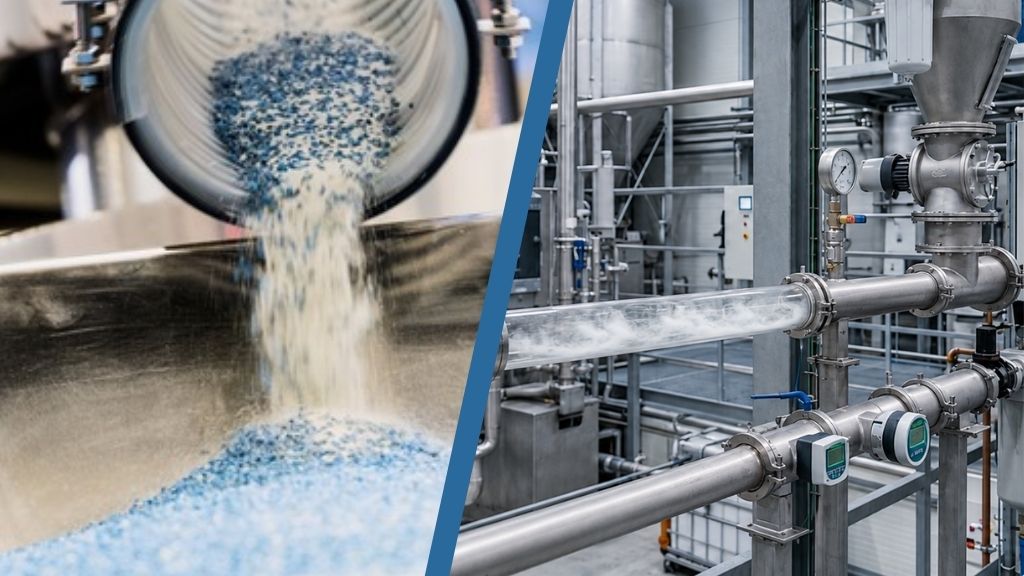
Fragile granules, crystals, pellets, agglomerates, flakes, and other sensitive materials can suffer degradation when feeding and conveying conditions are poorly controlled.
Unstable feeding can create periods of high solids concentration followed by high-velocity, low-solids transport. Repeated acceleration and impact can increase attrition and fines generation.
That can affect:
- Particle-size distribution
- Bulk density
- Appearance
- Flowability
- Dissolution characteristics
- Downstream processing
- Yield
Impact Across Key Processing Industries
| Industry | Material Examples | Impact of Poor Feeding & Velocity Surges |
|---|---|---|
| Polymers | Polyethylene (LLDPE/HDPE), Polypropylene (PP) Pellets, PVC Resins, PET Chips, Polystyrene | High friction and impact velocity cause localized frictional melting. This generates “angel hair” or streamers, clogging downstream receiver screens and contaminating batches. |
| Food Industry | Spray-Dried Milk Powder, Infant Formula, Instant Coffee Granules, Extruded Pet Food, Granulated Sugar, Wheat Flour | High impact energy breaks fragile agglomerates (Rittinger’s Law), converting premium instantized product into fines and dust. This creates caking issues and packaging weight errors. |
| Chemicals | Titanium Dioxide TiO2, Soda Ash, Carbon Black, Hydrated Lime, Organic Pigments, Catalyst Pellets | Fine cohesive powders tend to pack under pressure surges. Surging causes pipe wall coating, line plugs, and high pipe elbow wear from abrasive fines. |
The Solids-To-Air Ratio Is a Strategic Variable
One of the most useful ways to think about feeding is through the relationship between solids flow and gas flow. The conveying system is not simply moving “material through a pipe.” It is creating a controlled interaction between solids and gas.
If solids feed varies substantially while airflow remains fixed, the solids loading ratio varies.
If airflow is adjusted aggressively to compensate, conveying velocity varies.
Either way, the system is moving away from a stable operating point.
This is why sophisticated conveying systems increasingly focus on control of the process, rather than simply selection of individual components.
Stable feeding creates a more predictable solids loading.
Predictable loading enables more disciplined air management.
Better air management reduces unnecessary velocity.
Lower and more controlled velocity can reduce energy consumption, wear, and product damage.
In other words: Feeding stability is a multiplier.
It improves several downstream variables simultaneously.
What Leading Plants Are Measuring Differently
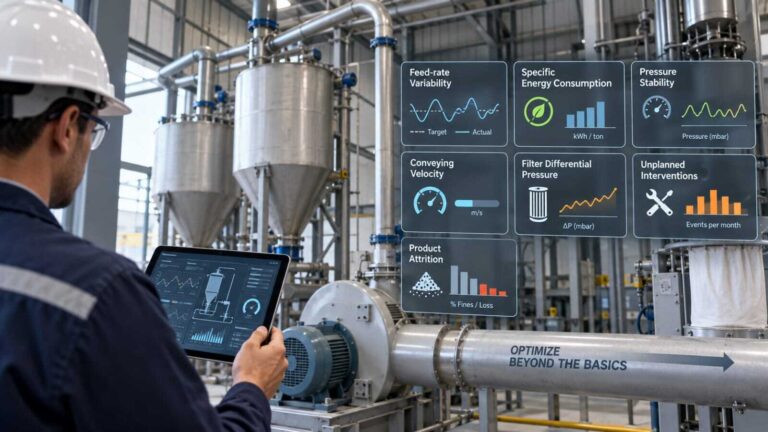
The most mature pneumatic conveying operations are moving beyond traditional KPIs such as:.
- Motor current
- Blower pressure
- Tones per hour
- Number of blockages
These remain useful, but they do not necessarily identify the root cause.
More revealing indicators include:
Feed-rate variability: How far does actual material delivery deviate from the target?
Specific energy consumption: How much electrical energy is consumed per ton conveyed?
Pressure stability: How much does conveying pressure fluctuate during steady-state operation?
Conveying velocity: Is the system operating faster than necessary?
Filter differential pressure: Is unstable conveying increasing dust loading?
Unplanned interventions: How frequently do operators need to adjust or reset the system?
Product attrition: How much usable product is converted into fines or otherwise lost?
Together, these measurements reveal whether the system is genuinely optimized – or simply being kept operational.
Conclusion:
Poor material feeding is rarely recorded as a single line item on a plant’s income statement.
Instead, its cost is scattered across electricity, maintenance, spare parts, lost production, labor, quality deviations, filter replacements, product waste, and operator intervention.
That fragmentation makes the problem easy to underestimate. But the physics do not care where the cost appears in the accounting system.
An unstable feed creates an unstable conveying process and an unstable conveying process forces every downstream component to compensate.
Pipeline Layout Is an Engineering Decision, not a Drafting Exercise
The feeder is not merely the beginning of the pipeline
It is the control point that determines how efficiently the entire pneumatic conveying system can operate.
When material feeding is stable, predictable, and matched to the conveying regime, the benefits compound: lower energy consumption, steadier throughput, less wear, fewer blockages, better product integrity, reduced operator intervention, and more predictable production.
That is why the hidden cost of poor feeding is ultimately much larger than the feeder itself: It is the cost of making the rest of the plant compensate for an unstable beginning.