
How to Convey PVC Powder Without Segregation
How to Convey PVC Powder Without Segregation
In PVC processing plants, maintaining a homogeneous powder mixture during material transfer is just as important as maintaining throughput. A perfectly formulated PVC dry blend can lose its designed characteristics if segregation occurs during conveying. This often results in inconsistent extrusion performance, unstable product quality, increased rejects, and unnecessary process adjustments.
Many engineers consider pneumatic conveying to be merely a means of transporting material from Point A to Point B. In reality, it is a process operation that directly influences the physical characteristics of the material. Every bend, velocity change, air distribution, cyclone, diverter valve, hopper, and discharge point has the potential to alter the composition of the blend.
The challenge becomes even greater because PVC dry blends are not single-component materials. They consist of PVC resin combined with stabilizers, lubricants, fillers, pigments, processing aids, impact modifiers, and various additives – each having different particle sizes, densities, and flow characteristics.
Designing a conveying system that preserves this carefully engineered mixture requires a deep understanding of powder behavior, particle dynamics, and conveying physics.
This article explores the engineering principles behind segregation, identifies where it occurs, and explains how properly designed pneumatic conveying systems can transport PVC powder while maintaining blend uniformity.
Understanding PVC Powder
Unlike free-flowing polymer pellets, PVC is often conveyed as a fine cohesive powder.
A typical PVC dry blend consists of:
| Component | Typical Characteristics |
|---|---|
| PVC Resin | Fine powder |
| Calcium Carbonate | Higher bulk density |
| Titanium Dioxide | Extremely fine and cohesive particles |
| Heat Stabilizers | Fine additives |
| Lubricants | Light, waxy particles |
| Processing Aids | Fine polymer powders |
| Pigments | Ultra-fine particles |
| Impact Modifiers | Low-density powder |
Although these ingredients appear uniformly mixed after blending, they possess significantly different:
- Particle size distributions
- Bulk densities
- Particle shapes
- Aeration characteristics
- Surface friction
- Cohesiveness
- Fluidization behavior
Why Segregation Occurs
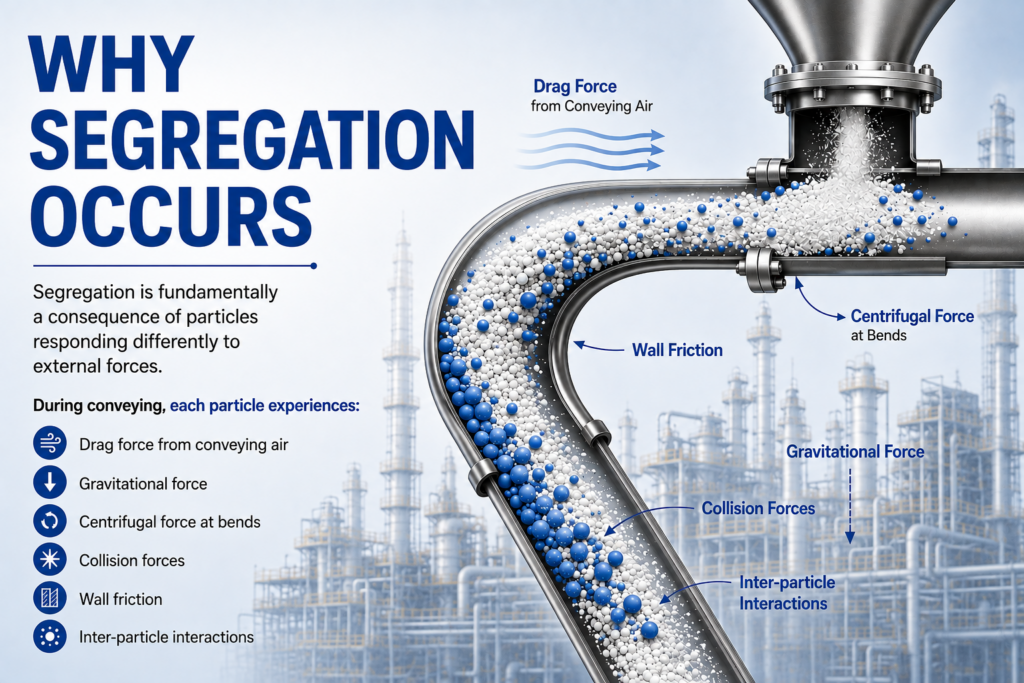
Segregation is fundamentally a consequence of particles responding differently to external forces.
During conveying, each particle experiences:
- Drag force from conveying air
- Gravitational force
- Centrifugal force at bends
- Collision forces
- Wall friction
- Inter-particle interactions
The Physics Behind Powder Segregation
Segregation is rarely caused by one mechanism alone. It is typically a combination of several physical phenomena acting simultaneously.
1. Particle Size Segregation
Fine particles experience greater aerodynamic drag than coarse particles.
Coarser particles possess greater inertia and tend to remain concentrated near the centre of the conveying stream, while ultrafine particles follow turbulent airflow patterns more readily.
Repeated acceleration and deceleration gradually create local concentration differences.
A 20% increase in air velocity increases impact energy by 44%!
2. Density Segregation
Calcium carbonate has considerably higher density than PVC resin.
During velocity fluctuations:
- Heavier particles resist acceleration
- Lighter particles accelerate rapidly.
- Small particles migrate downward through voids.
- Larger particles rise upward.
Segregation During Pneumatic Conveying
Although many engineers focus on pipelines, segregation can occur at every stage.
1. Feeding
- Incorrect rotary valve selection
- Uneven screw feeder discharge
- Air leakage
- Non-uniform feed rates
- All disturb the blend before conveying even begins
2. Pipeline Entry
High acceleration zones create differential particle velocities. Some additives immediately migrate toward the pipe wall.
3. Straight Pipelines
Turbulence continually redistributes particles. Over long distances this redistribution can become non-uniform.
4. Pipe Bends
Bends are the most critical locations. Heavier particles possess greater momentum. They impact the outer wall while lighter particles remain closer to the air stream. Repeated bends gradually separate the mixture.
5. Cyclones and Receivers
Poor cyclone efficiency may preferentially carry fine additives into dust collectors. The product entering the silo may therefore differ slightly from the original blend.
6. Storage Silos
Even if conveying is perfect, poor silo design can reintroduce segregation through funnel flow, rat-holing, or stagnant zones.
Engineering Laws Governing PVC Powder Segregation
The movement of every particle in a pneumatic conveying system is governed by classical mechanics, fluid dynamics, and bulk solids science. Understanding these principles enables engineers to design systems that maintain blend uniformity rather than inadvertently promoting segregation.
| Engineering Law / Principle | Governing Equation | Impact on PVC Powder Conveying | Engineering Design Consideration |
|---|---|---|---|
| Newton’s Second Law | F = ma | Particles of different masses accelerate differently under the same airflow, leading to velocity differences and segregation. | Minimize sudden acceleration and deceleration zones; ensure uniform material feeding. |
| Stokes’ Law | Fd = 3πμdV | Fine particles experience higher drag relative to their mass and remain suspended longer than coarse particles. | Prevent air classification by maintaining stable conveying conditions and properly designed receivers. |
| Terminal Settling Velocity | Depends on particle size, density and drag | Particles settle whenever conveying velocity falls below their terminal settling velocity. | Maintain conveying velocity above settling velocity but below excessive turbulence limits. |
| Reynolds Number | Re = ρVD / μ | Determines airflow regime. High turbulence increases random particle motion and segregation. | Optimize airflow to achieve stable suspension without excessive turbulence. |
| Bernoulli’s Principle | Pressure decreases as velocity increases | Pressure changes at bends, tees and transitions alter local airflow, causing uneven particle movement. | Avoid abrupt expansions and contractions; maintain smooth pipeline transitions. |
| Momentum Conservation | p = mv | Dense particles possess greater momentum and tend to continue straight at bends while lighter particles follow airflow. | Select long-radius bends and optimized pipeline layouts. |
| Centrifugal Force | Fc = mv²/r | Higher conveying velocities dramatically increase centrifugal separation at bends. | Use low conveying velocities and large-radius bends wherever possible. |
| Minimum Fluidization Velocity | Material specific | Light particles remain fluidized while heavy particles settle, causing segregation in receivers and silos. | Design hoppers and receivers to avoid uncontrolled fluidization. |
| Janssen’s Theory | Bulk solids pressure theory | Wall friction causes uneven stress distribution leading to stagnant zones and funnel flow. | Design silos to eliminate dead zones and ensure complete material movement. |
| Jenike’s Mass Flow Theory | Hopper flow theory | Funnel-flow hoppers promote segregation during discharge. | Design mass-flow hoppers using measured flow properties rather than empirical angles. |
| Kinetic Energy Principle | KE = ½mv² | Particle impact energy increases with the square of conveying velocity, increasing separation and attrition. | Operate at the lowest stable conveying velocity rather than the highest possible velocity. |
Engineering Strategies to Eliminate Segregation
The objective of pneumatic conveying is not simply to move powder – it is to preserve its engineered composition.
The following design practices significantly reduce segregation:
| Engineering Strategy | Technical Rationale |
|---|---|
| Maintain optimum conveying velocity | Prevents excessive turbulence while avoiding particle settling. |
| Ensure uniform solids loading | Reduces particle independence and maintains collective movement. |
| Design smooth pipeline layouts | Minimizes pressure fluctuations and particle separation. |
| Use engineered long-radius bends | Reduces centrifugal forces and wall impacts. |
| Control air distribution | Prevents localized acceleration and air classification. |
| Select appropriate pipeline diameter | Balances conveying velocity and solids loading ratio. |
| Design efficient receivers | Prevents selective removal of fine additives. |
| Implement mass-flow storage | Maintains first-in-first-out discharge and blend consistency. |
| Characterize powder properties | Enables design based on measured flow behavior rather than assumptions. |
The Engineering Philosophy
One of the most important lessons in pneumatic conveying is that segregation is fundamentally an energy-driven phenomenon.
Since centrifugal force and kinetic energy both increase with the square of conveying velocity, even a modest increase in air velocity can dramatically amplify particle separation, wall impacts, and material degradation.
Therefore, the guiding principle for PVC powder conveying should be:
This philosophy shifts the focus from maximizing conveying speed to optimizing conveying conditions—an approach that delivers superior product quality, reduced maintenance, lower energy consumption, and improved process reliability.
Conclusion:
Preventing segregation during PVC powder conveying is not achieved through a single piece of equipment or by selecting dense phase over dilute phase. It is the outcome of a carefully engineered system in which every component – from feeding and conveying to separation and storage – is designed to preserve the blend created in the mixer.
A successful PVC conveying system should do more than transport material efficiently. It should ensure that every kilogram reaching the extrusion line is compositionally identical to the material that left the blender. Achieving this requires an understanding of particle mechanics, powder flow, airflow dynamics, and equipment interaction.
As PVC processors pursue higher product consistency, reduced waste, and greater automation, conveying systems will increasingly be evaluated not only by their capacity but also by their ability to protect material integrity. In modern powder handling, preserving blend uniformity is no longer an operational preference – it is a defining measure of engineering excellence.