
How Pipeline Layout Affects Conveying Performance
How Pipeline Layout Affects Conveying Performance
When designing a pneumatic conveying system, most discussions focus on conveying capacity, blower selection, pipe diameter, or conveying mode. However, one of the most influential factors is often overlooked – the pipeline layout itself.
A pipeline is not merely a connection between a material source and a destination. It is an active component that directly affects pressure drop, conveying velocity, energy consumption, material degradation, equipment wear, and overall system reliability.
Two conveying systems handling the same material at the same capacity can perform very differently simply because their pipeline layouts are different. A system with excessive bends, abrupt directional changes, unnecessary vertical lifts, or poorly selected pipe diameters may require more energy, generate more fines, and experience frequent operational issues.
This is particularly important in industries handling bulk solids such as:
- Polymers – PP, PE, PET, PVC, ABS, Engineering Plastics
- Chemicals – Calcium Carbonate, Titanium Dioxide, Pigments, Detergent Powders, Additives
- Food & Beverage – Flour, Sugar, Starch, Milk Powder, Cocoa, Protein Powders
- Minerals – Cement, Fly Ash, Lime, Silica, Alumina, Sand
How Pipeline Layout Affects Conveying Performance
1. Pipeline Length
Every meter of pipeline creates resistance to flow.
As conveying air and solids travel through the pipeline, friction between the gas, particles, and pipe wall causes pressure loss. The longer the pipeline, the greater the pressure drop the conveying system must overcome.
While longer pipelines naturally require more conveying energy, total pipeline length alone does not determine system performance. The overall layout must also consider bends, elevation changes, and fittings.
The most effective design is not necessarily the shortest physical route, but the route that minimizes overall conveying resistance by strategically placing bends.
2. Pipe Diameter
Pipe diameter directly influences conveying velocity.
For a given airflow rate:
- Smaller pipe diameter increases velocity.
- Larger pipe diameter decreases velocity.
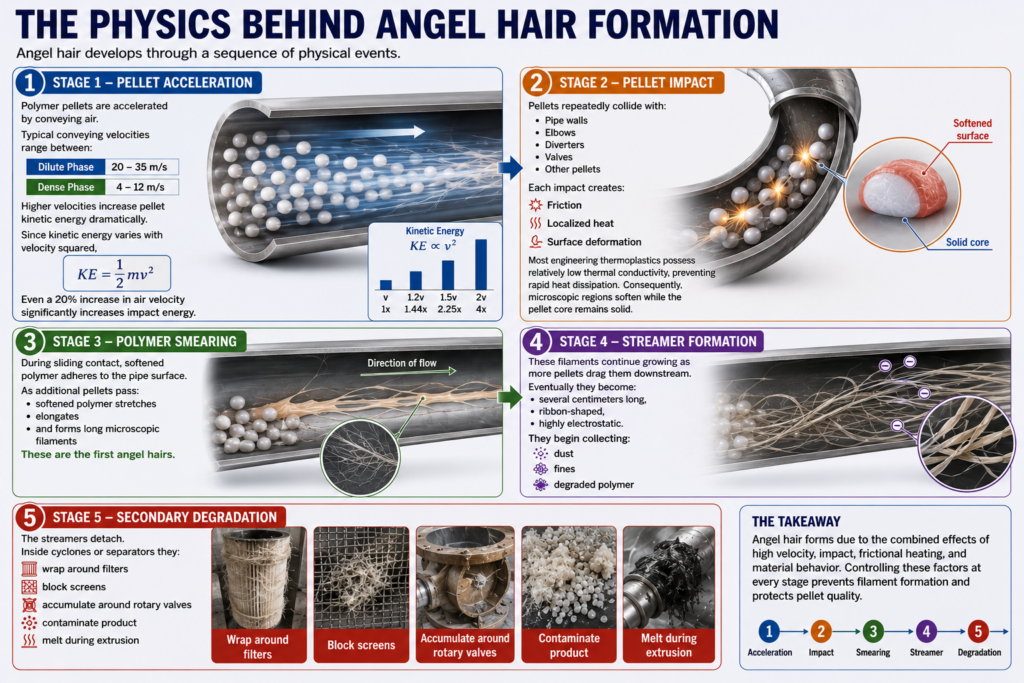
- Particle degradation
- Product attrition
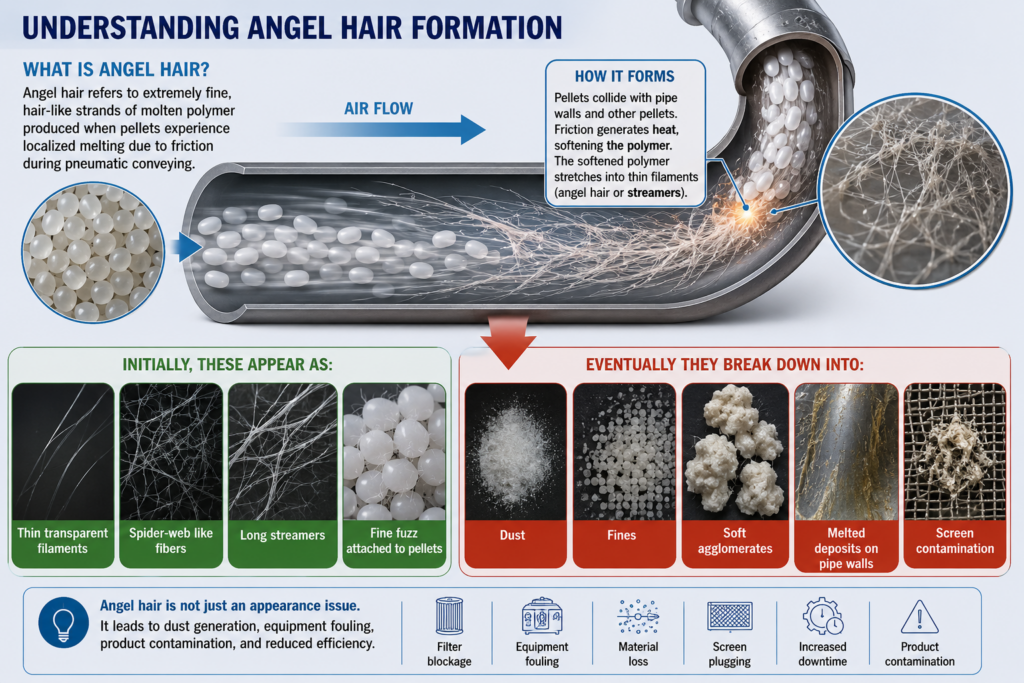
- Angel hair formation in polymer pellets
- Increased pipe wear
- Higher energy consumption
- Material settling
- Pipeline blockages
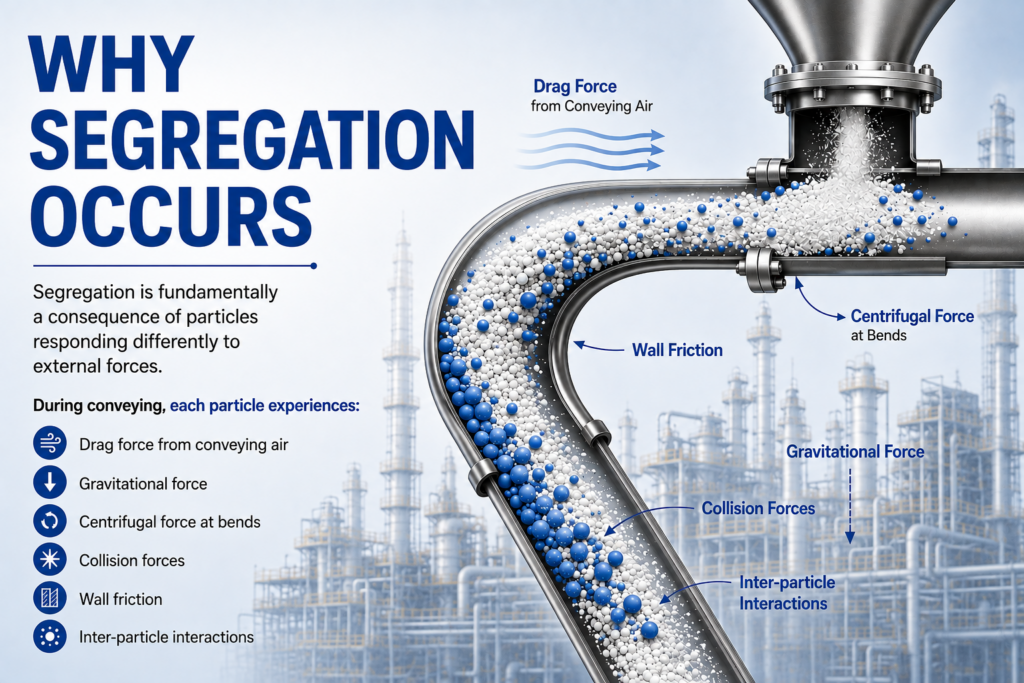
- Segregation
- Unstable conveying conditions
3. Bends and Directional Changes
Among all pipeline components, bends often have the greatest influence on conveying performance.
Unlike air, solid particles possess momentum. When particles encounter a bend, they naturally attempt to continue moving in their original direction. As a result, they impact the pipe wall before changing direction.
This creates:
- Additional pressure drop
- Particle velocity reduction
- Material degradation
- Pipe wear
- Increased energy requirements
4. Elevation Changes
Vertical conveying introduces an additional challenge: gravity.
When material is conveyed upward, the conveying gas must provide sufficient energy not only to overcome friction but also to lift the material.
As vertical height increases:
- Pressure requirements increase.
- Airflow requirements may increase.
- System operating margins become narrower.
Engineering Laws Governing Pipeline Layout
| Engineering Law / Principle | Relationship | Significance in Pneumatic Conveying |
|---|---|---|
| Continuity Equation | Q = A × V | Pipe diameter directly influences conveying velocity. |
| Bernoulli Principle | Pressure, velocity and elevation are interrelated. | Elevation changes affect pressure requirements. |
| Darcy-Weisbach Equation | Pressure loss increases with length and velocity. | Longer pipelines create higher pressure drops. |
| Momentum Conservation | Changing particle direction requires force. | Bends introduce momentum loss and pressure drop. |
| Kinetic Energy Principle | KE = ½mv² | Impact forces increase rapidly as velocity increases. |
| Reynolds Number | Determines flow characteristics. | Influences gas-flow behavior and friction losses. |
| Terminal Velocity Principle | Each particle has a minimum suspension velocity. | Velocity must remain above the settling limit. |
| Energy Conservation | Input energy must overcome all system losses. | Pipeline layout directly influences power consumption. |
| Wear-Velocity Relationship | Wear increases with particle impact velocity. | Critical for abrasive minerals and high-capacity systems. |
Effect of Pipeline Layout on Different Materials
| Industry | Typical Materials | Key Material Characteristics | Effect of Pipeline Layout | Consequences of Poor Layout |
|---|---|---|---|---|
| Polymer | PP, PE, HDPE, LLDPE, PET Chips, PVC, ABS | Relatively free-flowing; pellets/chips can be sensitive to impact and friction | Excessive bends and high velocities increase particle impact and can generate fines | Pellet breakage, fines generation, angel hair, dust, product degradation |
| Chemical | CaCO3, TiO2, Carbon Black, Pigments, Detergent Powders, Additives | Wide range of particle sizes; some powders are cohesive, fine or hygroscopic | Poor routing can increase pressure drop, material accumulation and segregation | Blockage, segregation, dust generation, inconsistent product quality |
| Food & Beverage | Flour, Sugar, Starch, Milk Powder, Cocoa, Protein Powders | Often fine, fragile and sensitive to contamination and moisture | Poor layouts can create retention zones and excessive particle impacts | Product degradation, contamination, material retention, cleaning difficulties |
| Minerals | Cement, Fly Ash, Silica, Alumina, Lime, Sand | Often dense and highly abrasive | Bends and high-velocity zones experience significant particle impact and erosion | Pipe erosion, frequent maintenance, pressure-drop increase, unplanned shutdowns |
| Specialty / Fine Powders | Battery powders, catalysts, pharmaceutical powders, specialty additives | Very fine, lightweight, cohesive or sensitive to contamination | Layout strongly affects dispersion, deposition, dust generation and product integrity | Dusting, deposition, segregation, contamination, unstable conveying |
Bend and Routing Optimization
Because bends are often the largest contributors to pressure loss and wear, their design deserves special attention.
Ø Minimize Bend Count
Every bend introduces additional resistance.
A route with fewer bends will generally provide:
- Lower pressure drop
- Reduced energy consumption
- Less product degradation
- Improved system reliability
Ø Use Appropriate Bend Geometry
Long-radius bends typically provide smoother directional changes than short-radius bends.
Benefits include:
- Lower impact forces
- Reduced pressure loss
- Lower wear rates
- Improved product quality
Ø Avoid Clustering Bends
When multiple bends are installed close together, particles may not have sufficient distance to stabilize before entering the next bend.
This can result in:
- Higher pressure losses
- Increased turbulence
- Greater particle degradation
- Choking potential
Ø Consider Future Expansion
Pipeline layouts should accommodate future plant requirements.
Designing for future capacity increases can help avoid costly modifications later.
Key considerations include:
- Spare conveying capacity
- Additional destination points
- Future production increases
- Equipment accessibility
Pipeline Layout Optimization Checklist
| Parameter | Engineering Consideration |
|---|---|
| Pipeline Length | Eliminate unnecessary routing wherever possible. |
| Pipe Diameter | Maintain suitable conveying velocity. |
| Number of Bends | Minimize directional changes. |
| Bend Radius | Use appropriate long-radius geometry where feasible. |
| Vertical Lifts | Reduce unnecessary elevation changes. |
| Velocity Profile | Ensure velocity remains within the material’s operating window. |
| Material Characteristics | Consider particle size, density, abrasiveness and fragility. |
| Pressure Drop | Calculate total system resistance, not just pipe length. |
| Wear Zones | Identify high-impact areas and provide protection if required. |
| Product Quality | Evaluate risk of degradation, dust generation and segregation. |
| Maintenance Access | Ensure inspection and replacement points are accessible. |
| Future Capacity | Allow flexibility for plant expansion. |
Conclusion:
Pipeline layout has a profound influence on pneumatic conveying performance. It affects how efficiently energy is transferred, how materials behave within the pipeline, and ultimately how reliably the entire conveying system operates.
Length, diameter, bends, and elevation changes all contribute to the pressure and velocity profile experienced by the material. When these factors are properly engineered, conveying systems achieve higher capacities, lower operating costs, reduced maintenance, and improved product quality.
Whether conveying polymer pellets, chemical powders, food ingredients, or abrasive minerals, successful pneumatic conveying begins with understanding that the pipeline is not simply a route – it is a critical process component.
The most effective conveying systems are therefore not designed around the shortest path between two points, but around the path that best manages pressure, velocity, material integrity, and energy consumption.
Pipeline Layout Is an Engineering Decision, not a Drafting Exercise