
Engineering the Bag-to-Process Journey in Automated Material Handling Systems
Engineering the Bag-to-Process Journey in Automated Material Handling Systems
In modern manufacturing environments, substantial capital investments are directed toward high-performance process equipment such as reactors, extruders, mixers, and automated packaging lines. However, a critical yet often overlooked interface lies upstream – the transition of bulk materials from bag to process. This stage, commonly referred to as bag unloading and material feeding, plays a decisive role in overall process efficiency and product quality.
Despite its apparent simplicity, the operation of emptying bags and transferring material into downstream systems has traditionally relied on manual intervention. This introduces multiple inefficiencies, including inconsistent discharge rates, uncontrolled dust generation, and variability in material flow. More importantly, it becomes a key point where process variability is introduced – through contamination risks, material spillage and losses, operator-dependent performance, and fluctuating feed rates that directly impact downstream equipment such as feeders, mixers, and reactors.
As industries increasingly adopt automated material handling systems, with a focus on process reliability, traceability, and Industry 4.0 integration, the “bag-to-process” stage is evolving from a manual utility function into a strategic control point.
In this blog, you will gain a comprehensive understanding of how an integrated “bag-to-process” system is engineered – from bag unloading and conveying to storage, flow conditioning, feeding, and mixing – and how each stage contributes to achieve reliable, efficient, and high-quality manufacturing operations.
The Shift: From Manual Dependency to Intelligent Systems
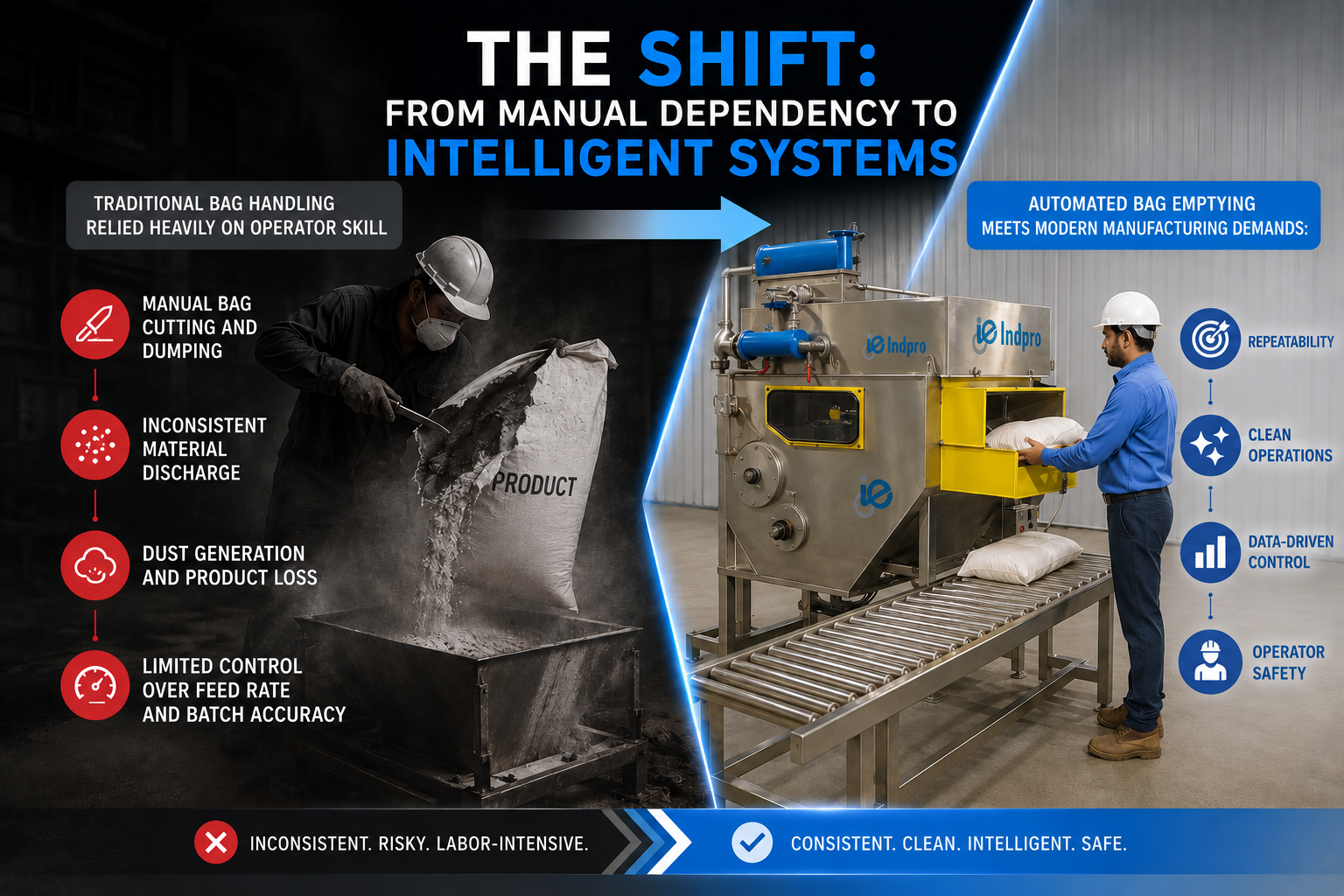
Traditional bag handling relied heavily on operator skill:
- Manual bag cutting and dumping
- Inconsistent material discharge
- Dust generation and product loss
- Limited control over feed rate and batch accuracy
However, modern manufacturing demands:
- Repeatability
- Clean operations
- Data-driven control
- Operator safety
This shift is driving the adoption of automated material handling solutions, transforming the “bag-to-process” step into a controlled, integrated, and intelligent operation.
Engineering the Transition: Key Elements of Automation
1. Controlled Bag Unloading Systems – For Small Bag (25 kg/ 50 kg) & Jumbo Bag
Automated bag unloading stations (automatic bag slitting machines/jumbo bag unloading stations) are no longer just dumping points – they are engineered systems designed for:
- Dust-free operation through integrated aspiration
- Controlled discharge using agitation, massage paddles, or vibration
- Adaptability for different bag types (woven, paper, liners)
- Preservation of material integrity (especially for fragile or friable materials)
- Minimization of segregation
- Controlled velocity profiles to prevent degradation
- Storage silos for bulk accumulation and process decoupling
- Day bins / surge hoppers for short-term, controlled feeding
- Bin Activators – Induce vibration and promote mass flow
- Fluidized Beds / Aeration Pads – Reduce inter-particle friction for fine powders
- Powder Bridge Breakers – Eliminate arching and rat-holing
- Loss-in-weight feeders
- Screw feeders with variable frequency drives
- Rotary airlock valves for metered discharge
- Precise dosing into downstream processes
- Batch consistency
- Integration with PLC/SCADA systems
- Reaction kinetics
- Mixing efficiency
- Flowability and packing density
- Removing excess moisture
- Enhancing shelf life
- Improving flow characteristics
- Horizontal mixers (Ribbon/Paddle/Plough): Ideal for rapid, high-capacity blending
- Vertical mixers (Ribbon/Paddle): Suitable for gentle mixing and energy-efficient operations
- Consistent feed rates for reaction stability
- Controlled particle size for reaction efficiency
- Contamination-free input for product purity
- Phase changes
- Material conditioning
- Reaction control
- Uniform feed composition
- Controlled bulk density
- Stable feed rates
- Product defects
- Inconsistent shapes or densities
- Increased rejection rates
- Product yield
- Operator health
- Regulatory compliance
Beyond Equipment: System Thinking
A common mistake is treating bag handling as a standalone equipment selection problem. In reality, it is a system design challenge.
Key questions include:
- How does material behavior change from storage to discharge?
- What is the required feed consistency for the downstream process?
- How can variability be eliminated across shifts and operators?
- How does this integrate with plant automation architecture?
Why Automation Matters?
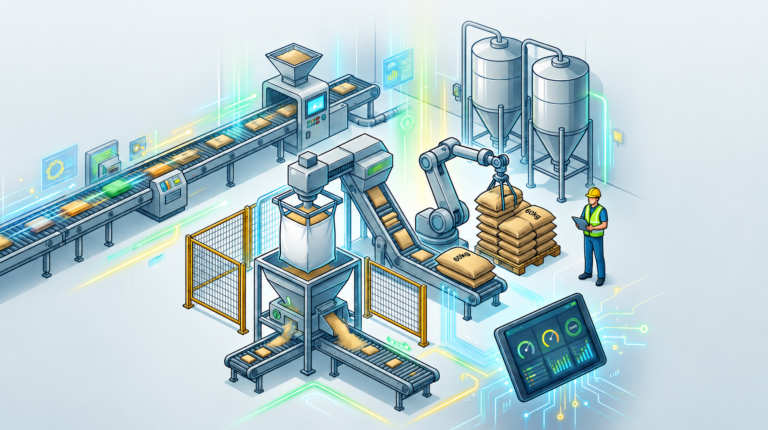
1. Operational Efficiency: Reduced manual intervention leads to faster cycle times and higher throughput
2. Consistency and Quality: Controlled feeding ensures uniform product quality and process stability
3. Safety and Ergonomics: Eliminates repetitive manual handling, reducing workplace injuries
4. Material Savings: Minimizes spillage, dust losses, and incomplete bag discharge
5. Data and Traceability: Enables integration with Industry 4.0 systems for monitoring and optimization
Emerging Trends: The Future of Bag-to-Process Systems
Smart Material Handling: Sensors, load cells, and AI-driven analytics are enabling predictive control over material flow behavior.
Modular System Design: Plug-and-play modules allow flexible scaling and faster deployment.
Hygienic Solutions: Driven by pharmaceutical and food industries, designs are evolving for zero contamination and high levels of hygiene.
Containment Solutions: The need for chemical industries includes complete containment solutions for zero exposure of operators to toxic and hazardous materials.
Digital Integration: Seamless integration with MES and ERP systems is making material handling a data-rich node in the production ecosystem.
Conclusion: From Utility to Strategic Advantage
The journey from bag to process is no longer an ordinary operational step – it is a critical control point that defines process efficiency, product quality, and operational safety.
Organizations that recognize this shift are moving beyond basic handling solutions toward engineered, automated, and intelligent systems.
In doing so, they are not just improving material flow – they are unlocking a new level of process reliability and competitive advantage.