
How to Select the Right Industrial Mixer for Your Process
How to Select the Right Industrial Mixer for Your Process
In most industrial plants, mixing is treated as a simple unit operation – something that happens between material handling and downstream processing. But in reality, mixing is often the single most influential factor in determining product quality, batch consistency, and overall process efficiency.
Yet, mixer selection is still commonly driven by equipment specifications – RPM, motor power, or vendor preference – rather than the process requirements themselves.
This approach leads to a familiar set of problems: inconsistent batches, long mixing times, product degradation, and costly rework.
The truth is straightforward:
You don’t select a mixer – you engineer a mixing process.
1. Start With the Process Objective, Not the Equipment
Before evaluating any mixer type, the first question must be: What exactly are you trying to achieve through mixing?
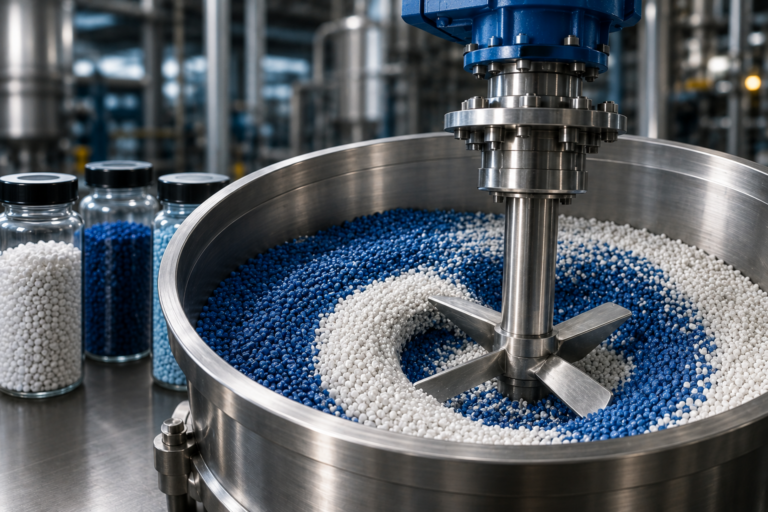
Different objectives demand fundamentally different mixing mechanisms:
- Homogenization → Uniform composition across the batch
- Blending → Even distribution of multiple components
- Dispersion → Breaking agglomerates into finer particles
- Coating → Applying liquid onto solid particles
- Heat Transfer → Heating or cooling during mixing
- Shear intensity
- Flow pattern
- Residence time
However, modern manufacturing demands:
- Repeatability
- Clean operations
- Data-driven control
- Operator safety
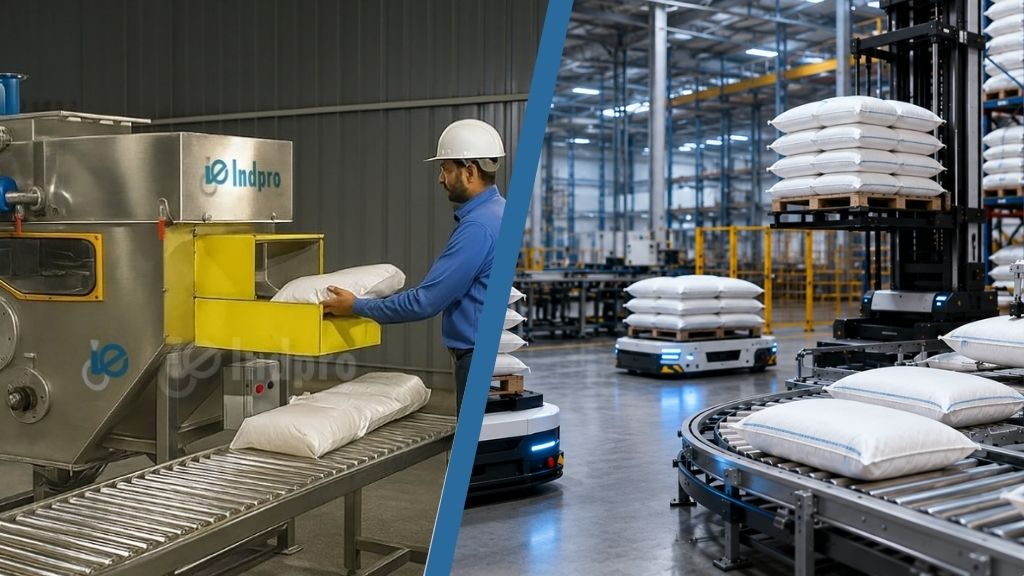
This shift is driving the adoption of automated material handling solutions, transforming the “bag-to-process” step into a controlled, integrated, and intelligent operation.
2. Understand Material Behavior - Not Just Material Properties
Datasheets provide parameters like bulk density or particle size—but real-world mixing depends on how materials behave dynamically.
Key questions to evaluate:
- Are the materials cohesive, free-flowing, or sticky?
- Is there a wide variation in particle size distribution?
- Are components prone to segregation?
- Does the material exhibit shear sensitivity or degradation?
- Fine powders may form agglomerates requiring higher shear.
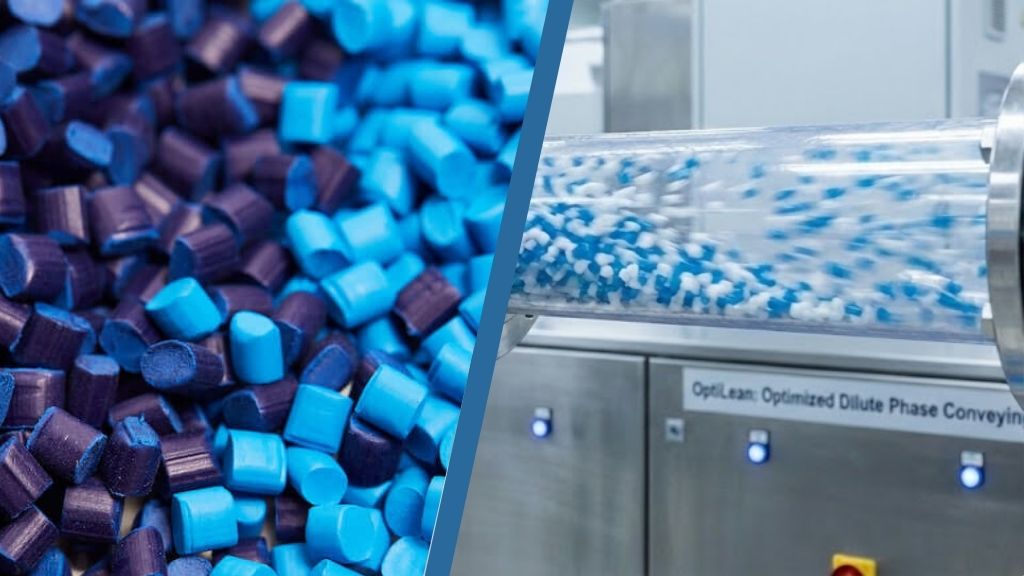
- Fragile particles (like polymer granules) may degrade under excessive mixing intensity.
- Density differences can cause segregation even after achieving initial homogeneity.
3. Define the Required Degree of Homogeneity
Not all processes require the same level of mixing precision.
A critical—but often overlooked—parameter is:
“How uniform is uniform enough?”
- Commodity products may tolerate ±5–10% variation
- Specialty chemicals or food products may require <1% deviation
- Better flow control
- Optimized mixing geometry
- Longer or more controlled mixing cycles
Overdesigning for unnecessary precision increases CAPEX and OPEX – while underdesigning compromises quality.
4. Evaluate Batch Size, Throughput, and Flexibility
Mixer selection must align with production realities:
- Minimum and maximum batch size
- Production rate (TPH or batches/day)
- Frequency of product changeovers
- Ease of cleaning for batch changeover
- Large mixers improve throughput but reduce flexibility
- Smaller systems improve control but may limit scalability
- Complex mixers are often difficult to clean
5. Mixing Time vs Energy Consumption: Finding the Balance
A common misconception is that faster mixing always improves productivity.
In reality:
- Excessive mixing can lead to product degradation
- High energy input increases operating costs
- Overmixing may cause segregation in powders
6. Consider Process Integration, Not Standalone Equipment
A mixer does not operate in isolation. Its performance depends heavily on upstream and downstream systems:
- Feeding accuracy (loss-in-weight, batching systems)
- Type of conveying systems upstream & downstream
- Discharge mechanisms
- Automation and recipe control
Poor integration often leads to:
- Inconsistent feed rates
- Uneven loading
- Extended cycle times
- Segregation post mixing
The most effective mixing systems are designed as part of a fully integrated process line.
7. Address Cleaning, Maintenance, and Changeover
In industries like food, chemicals, and specialty materials, cleaning is not a secondary concern – it is a critical design parameter.
Evaluate:
- Ease of cleaning (manual or CIP)
- Dead zones or material hold-up areas
- Accessibility for maintenance
- Time required for product changeover
A mixer that performs well but requires long cleaning cycles will reduce overall plant productivity.
8. Plan for Scale-Up From Day One
One of the most common industry mistakes is assuming that a mixer that works in the lab will perform the same at production scale.
In reality, scale-up introduces challenges such as:
- Different flow patterns
- Variations in power per unit volume
- Changes in residence time distribution
Successful scale-up requires:
- Geometric consistency
- Process validation
- Engineering expertise – not trial and error
9. Don’t Ignore Automation and Control
Modern mixing is no longer just mechanical – it is increasingly digital.
Advanced systems now incorporate:
- PLC-based recipe control
- Real-time monitoring
- Batch traceability
- Integration with plant-wide automation
Automation ensures:
- Repeatability
- Reduced operator dependency
- Consistent product quality
10. The Right Mixer Is the Outcome - Not the Starting Point
Ultimately, selecting the right industrial mixer is not about choosing between designs – it is about engineering the right process conditions.
The correct approach is:
1. Define process objectives
2. Understand material behavior
3. Establish quality requirements
4. Evaluate operational constraints
5. Design for integration and scalability
6. Conduct trials and validate claims
Only then does the mixer type become clear.
Selection of Mixer – A Practical Decision Framework
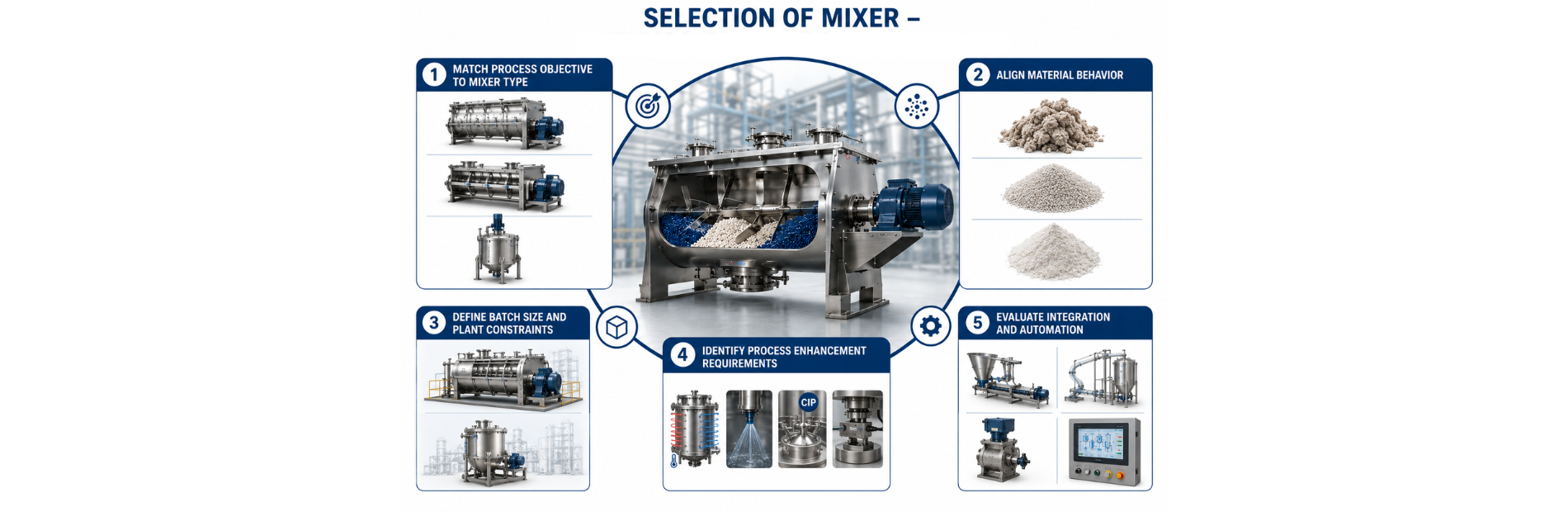
Once the process foundation is established, the final mixer selection can be made using a structured engineering approach:
Step 1: Match Process Objective to Mixer Type
Align the mixing requirement with the appropriate mechanism:
- Blending applications → Ribbon or Paddle mixers
- High-intensity mixing / dispersion → Plough Shear mixers
- Gentle handling of fragile materials → Paddle mixers (Horizontal or Vertical)
This ensures the selected mixer delivers the required flow dynamics and shear profile.
Step 2: Align Material Behavior
Material characteristics refine the selection:
- Cohesive or agglomerated powders → Plough Shear mixers for intensive mixing
- Free-flowing materials → Ribbon mixers for efficient bulk blending
- Fragile or shear-sensitive materials → Paddle mixers for controlled, low-impact mixing
Correct alignment prevents issues such as segregation, degradation, or inefficient mixing.
Step 3: Define Batch Size and Plant Constraints
Operational realities play a critical role:
- Large batch sizes / high throughput → Horizontal Process Mixers
- Space constraints / flexible operations → Vertical Process Mixers
This step ensures the mixer fits both production demand and plant layout.
Step 4: Identify Process Enhancement Requirements
Modern mixing systems often require additional process capabilities:
- Heating or cooling requirements → Jacketed mixers
- Liquid addition / coating applications → Integrated liquid injection systems
- Hygiene-critical or multi-product plants → CIP (Clean-In-Place) systems
- High accuracy and repeatability → Load cell-based weighing systems
These features transform the mixer into a controlled and repeatable process unit, rather than just a mechanical device.
Step 5: Evaluate Integration and Automation
Finally, ensure seamless integration with the overall process:
- Feeding systems (loss-in-weight, batching)
- Pneumatic or mechanical conveying
- Discharge mechanisms
- PLC-based automation and recipe control
A well-integrated mixer ensures:
- Consistent batch quality
- Reduced operator dependency
- Improved overall plant efficiency
Final Thought: Shift From Equipment Selection to Process Engineering
The most successful plants don’t ask: “Which mixer should we buy?”
They ask: “What process conditions are required to achieve consistent, scalable results?”
This shift – from equipment-centric thinking to process-centric engineering – is what separates average operations from high-performance manufacturing systems.
Because in the end,
mixing is not about motion or emotion – it’s about precision, consistency, and control.