
How to Eliminate Angel Hair in Polymer Conveying: An Engineering Guide
How to Eliminate Angel Hair in Polymer Conveying:
An Engineering Guide
For polymer processors, compounders, masterbatch manufacturers, resin producers, and packaging manufacturers, product quality begins long before extrusion or molding. The integrity of every polymer pellet transported through the plant directly influences production efficiency, product consistency, equipment reliability, and ultimately customer satisfaction.
One of the most persistent yet underestimated problems in polymer conveying systems is angel hair formation – the generation of extremely thin polymer filaments that originate during high-velocity pellet transport. While these fine strands may appear insignificant initially, they progressively evolve into streamers, dust, and fused agglomerates that contaminate production lines, clog filters, interfere with feeding systems, and reduce overall plant efficiency.
Unlike conventional maintenance issues, angel hair is fundamentally an engineering problem involving conveying velocity, material science, pipeline geometry, air dynamics, electrostatic effects, and equipment design.
The encouraging aspect is that angel hair is largely preventable. With correctly engineered conveying systems, its generation can be minimized to near-zero levels.
This article explores the science behind angel hair formation, explains why it occurs, and presents engineering solutions for designing polymer conveying systems that eliminate the problem at its source.
Understanding Angel Hair Formation
What is Angel Hair?
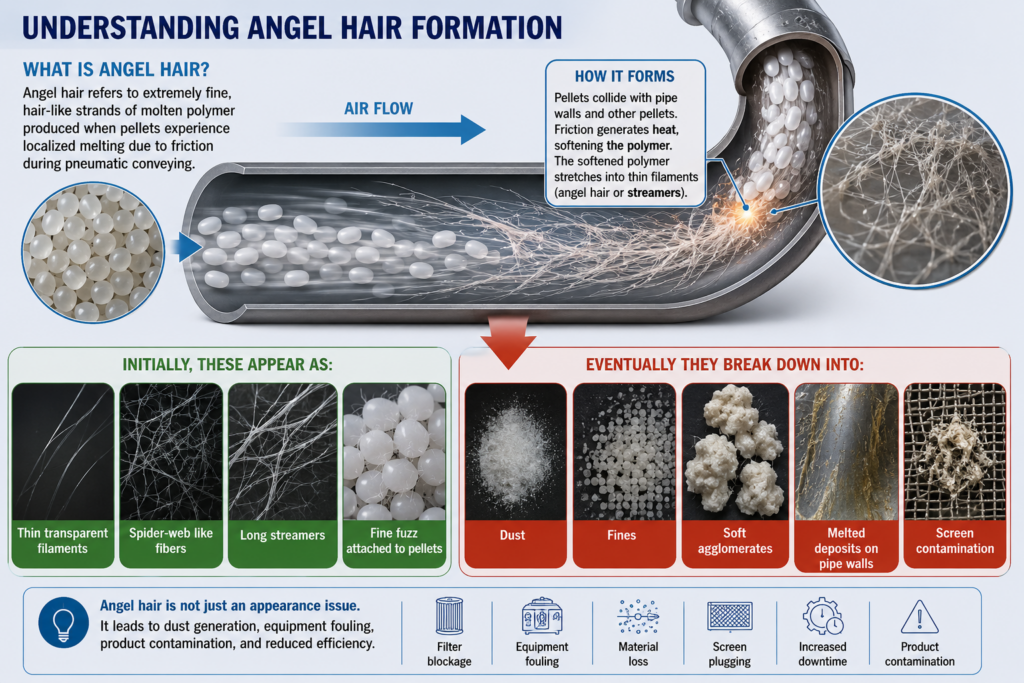
Angel hair refers to extremely fine, hair-like strands of molten polymer produced when pellets experience localized melting due to friction during pneumatic conveying.
Initially, these appear as:
- Thin transparent filaments
- Spider-web like fibers
- Long streamers
- Fine fuzz attached to pellets
Eventually they break down into:
- Dust
- Fines
- Soft agglomerates
- Melted deposits on pipe walls
- Screen contamination
Unlike degraded polymer resulting from thermal processing, angel hair is generated solely during mechanical conveying.
The Physics Behind Angel Hair Formation
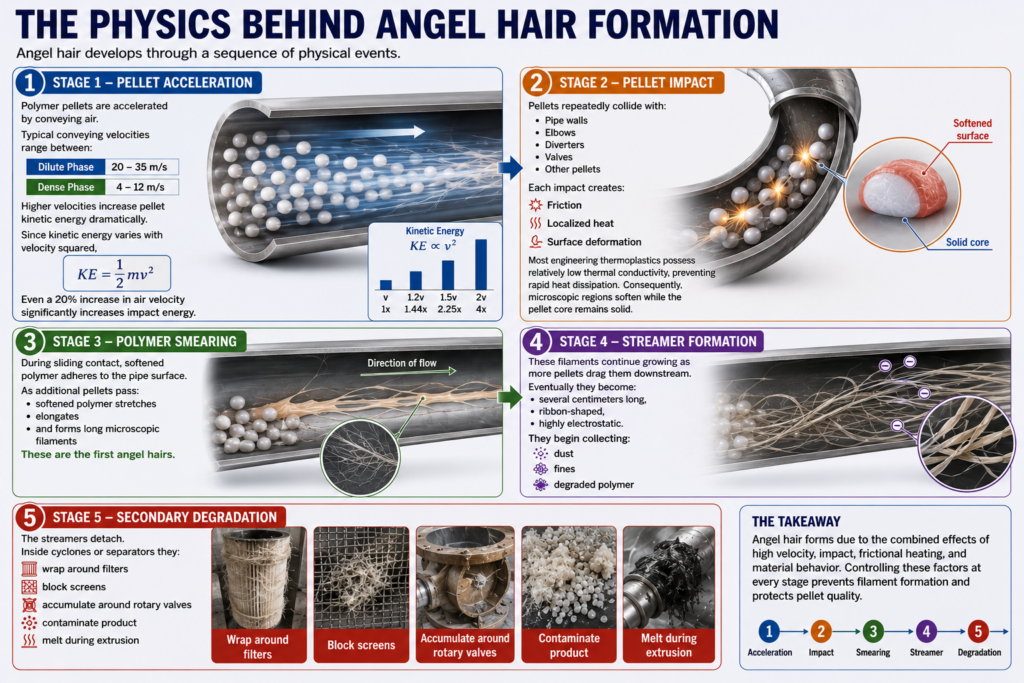
Angel hair develops through a sequence of physical events.
Stage 1 – Pellet Acceleration
Polymer pellets are accelerated by conveying air. Typical conveying velocities range between:
- Dilute Phase: 20 – 35 m/s
- Dense Phase: 4 – 12 m/s
A 20% increase in air velocity increases impact energy by 44%!
Stage 2 – Pellet Impact
Pellets repeatedly collide with:
- Pipe walls
- Elbows
- Diverters
- Valves
- Other pellets
- Friction
- Localized heat
- Surface deformation
Stage 3 – Polymer Smearing
During sliding contact, softened polymer adheres to the pipe surface.
As additional pellets pass:
- softened polymer stretches
- elongates
- and forms long microscopic filaments
Angel hair develops through a sequence of physical events.
Stage 1 – Pellet Acceleration
Polymer pellets are accelerated by conveying air. Typical conveying velocities range between:
- Dilute Phase: 20 – 35 m/s
- Dense Phase: 4 – 12 m/s

A 20% increase in air velocity increases impact energy by 44%!
Stage 2 – Pellet Impact
Pellets repeatedly collide with:
- Pipe walls
- Elbows
- Diverters
- Valves
- Other pellets
- Friction
- Localized heat
- Surface deformation
Stage 3 – Polymer Smearing
During sliding contact, softened polymer adheres to the pipe surface.
As additional pellets pass:
- softened polymer stretches
- elongates
- and forms long microscopic filaments
Stage 4 – Streamer Formation
These filaments continue growing as more pellets drag them downstream.
Eventually they become:
- several centimeters long,
- ribbon-shaped,
- highly electrostatic.
- dust,
- fines,
- degraded polymer.
Stage 5– Secondary Degradation
The streamers detach.As additional pellets pass:
Inside cyclones or separators, they:
- wrap around filters
- block screens
- accumulate around rotary valves
- contaminate product
- melt during extrusion
Engineering Principles Behind Angel Hair Formation
Angel hair formation is not merely a consequence of “high conveying velocity”; it is the result of multiple engineering phenomena occurring simultaneously. Understanding these underlying principles enables engineers to design conveying systems that prevent degradation at its source rather than relying on downstream corrective measures.
1. Tribology: The Science of Friction and Wear
At its core, angel hair formation is a tribological phenomenon. Tribology is the science of friction, wear, and lubrication between interacting surfaces in relative motion.
During pneumatic conveying, polymer pellets repeatedly interact with:
- Pipeline walls
- Pipe bends and elbows
- Diverter valves
- Other moving pellets
Each interaction generates frictional forces that convert mechanical energy into heat. Although the bulk conveying air temperature may remain close to ambient, localized contact regions experience significantly higher temperatures due to friction.
The amount of frictional energy generated is governed by Coulomb’s Law of Friction: F=μN
Where:
F = Frictional force
μ = Coefficient of friction
N = Normal contact force
Reducing either the coefficient of friction or the impact force through optimized conveying velocities, smoother pipe surfaces, and improved pipeline layouts directly minimizes the likelihood of polymer softening.
2. Blok’s Flash Temperature Theory
One of the most important yet often overlooked mechanisms responsible for angel hair is Flash Temperature Theory, first proposed by Dutch engineer Hugo Blok.
Unlike bulk temperature measurements, flash temperature refers to the instantaneous microscopic temperature rise occurring at the exact point where two surfaces slide against each other.
During pellet-wall contact:
- Contact duration is only a few milliseconds.
- The contact area is extremely small.
- Frictional energy is concentrated within microscopic regions.
As a result, localized temperatures can briefly exceed the polymer’s softening or Vicat temperature even though the average conveying temperature remains far below the melting point.
These softened regions are then stretched by subsequent pellets into the thin filaments known as angel hair.
3. Hertzian Contact Mechanics
Every collision between a polymer pellet and a conveying pipeline creates localized stresses described by Hertzian Contact Theory.
Although pneumatic conveying systems operate at relatively low pressures, the actual contact area between a spherical pellet and the pipeline wall is extremely small. Consequently, the localized contact stress can become remarkably high.During pellet-wall contact:
Repeated impacts lead to:
- Surface deformation
- Increased friction
- Micro-scale heat generation
- Polymer softening
- Initiation of streamer formation
This explains why improperly designed elbows and sudden directional changes are often the primary locations where angel hair begins to develop.
4. Viscoelastic Behaviour of Thermoplastics
Unlike brittle materials, thermoplastics exhibit viscoelastic behaviour, possessing both elastic and viscous characteristics.
When exposed to localized frictional heating:
- The pellet surface softens.
- The polymer becomes ductile rather than brittle.
- Instead of fracturing, the softened polymer elongates under tensile forces.
This unique viscoelastic response enables polymer surfaces to stretch into extremely thin continuous filaments, which subsequently develop into streamers and eventually break down into fines and dust.
Materials such as LDPE, LLDPE, and HDPE are particularly susceptible because of their relatively low softening temperatures and high elongation characteristics.
5. Fluid Dynamics and Conveying Velocity
The airflow characteristics within pneumatic conveying systems are governed by fundamental principles of fluid dynamics.
Pressure losses through conveying pipelines can be approximated using the Darcy-Weisbach Equation: 
where:
ΔP = Pressure drop
f = Friction factor
L = Pipeline length
D = Pipe diameter
ρ = Air density
V = Air velocity
The equation demonstrates that pressure loss increases approximately with the square of conveying velocity. Consequently, increasing blower speed not only raises energy consumption but also significantly increases pellet impact energy, frictional heating, and the likelihood of angel hair formation.
Engineering Design Strategies to Eliminate Angel Hair
An effective solution requires addressing the root causes rather than treating the symptoms. Best practices include:
1. Design for the Lowest Practical Conveying Velocity
Balance pickup velocity with stable transport, avoiding unnecessary safety margins that increase pellet impact energy.
2. Optimize Pipeline Routing
Use the shortest practical route with minimal directional changes, long-radius bends, and smooth transitions.
3. Specify Wear-Resistant, Low-Friction Components
Employ polished stainless-steel pipelines, specialized elbows, and abrasion-resistant linings where appropriate.
4. Optimize Air-to-Material Ratio
Use engineering calculations rather than rules of thumb to maintain stable conveying conditions across the full operating range.
5. Implement Variable-Speed Air Control
Variable frequency drives (VFDs) on blowers enable conveying velocity to be matched to throughput, preventing over-conveying during partial loads.
6. Install Efficient Separation Systems
Cyclones, receiver bins, and filtration systems should minimize pellet impact while effectively removing conveying air.
7. Monitor System Performance
Track differential pressure, airflow, pellet breakage, dust levels, and pipeline wear to detect conditions that promote angel hair before they become chronic.
Beyond Prevention: Technologies for Removing Residual Angel Hair
While optimized conveying system design remains the most effective method for eliminating angel hair, some applications – particularly high-throughput conveying systems, long conveying distances, and recycled polymer processing – may still generate small quantities of streamers. In such cases, pellet cleaning technologies provide an additional layer of protection before the material enters downstream processing equipment.
Angel Hair Trap
- Captures long streamers mechanically.
- Best installed immediately after the receiver.
- Prevents downstream accumulation.
- Does not remove dust or fines.
Pellet Dedusting System (e.g., PelletPurge®)
- Removes angel hair, streamers, dust, fines, and surface contamination.
- Delivers the highest pellet cleanliness.
The Hidden Cost of Angel Hair
Many plants underestimate the cumulative financial impact of streamer formation.
Typical consequences include:
- Increased filter replacement frequency
- Higher maintenance downtime
- Product contamination and customer complaints
- Material losses through fines generation
- Blocked rotary valves and receivers
- Increased cleaning frequency
- Extruder screen pack plugging
- Reduced equipment life
- Higher energy consumption due to inefficient conveying
Conclusion:
Angel hair is not an inevitable by-product of polymer conveying – it is a symptom of suboptimal system design. High conveying velocities, excessive pellet impact, poor pipeline geometry, inappropriate air-to-material ratios, and inadequate component selection all contribute to its formation.
By adopting an engineering-led approach that integrates optimized conveying velocities, smooth pipeline layouts, advanced elbow designs, precise airflow control, manufacturers can substantially reduce or eliminate angel hair at its source.
For industries processing high-value polymer resins, protecting pellet integrity is more than a maintenance objective; it is a strategic investment in product quality, operational reliability, and long-term profitability.
In today’s competitive plastics industry, the most efficient conveying systems are those that move material gently, consistently, and intelligently – delivering every pellet to the process in the same condition in which it was produced.